The premium dog food bag says 300g a day, so your dog needs exactly 300g, right? Not necessarily.
One of the most common questions dog owners ask is: “How much should I feed my dog?”
The answer isn't quite as simple as following the number printed on the bag.
Feeding guides are useful, but they're exactly that… a guide and a starting point.
Your dog's actual requirements depend on the individual dog.
Why Feeding Guides Aren't An Exact Prescription
Most complete dog foods provide a feeding table based primarily on your dog's weight.
That's a useful place to start, but two dogs weighing exactly 20kg can have very different energy requirements.
Think about a young, active dog running for two hours every day compared with an older 20kg dog enjoying a couple of gentle walks.
Same weight. Very different lifestyle.
Factors that can affect how much your dog needs include:
- Weight and ideal weight
- Body condition
- Age and life stage
- Activity level
- Breed and body composition
- Neutering
- Health conditions
- Environment and lifestyle
- The calorie density of the food
That's why we don't recommend treating the number on the packet as an exact prescription.
300g Of One Food Isn't The Same As 300g of Another
This is really important when changing dog foods.
Different foods contain different amounts of energy.
Your dog might require 300g per day of one food but considerably more or less of another to receive a similar amount of energy.
So if you're changing foods, don't automatically continue feeding exactly the same number of grams.
Check the new manufacturer's feeding guidance and adjust according to your dog's individual requirements and body condition.
Weigh It, Don't Guess It
It's surprisingly easy for portions to creep upwards.
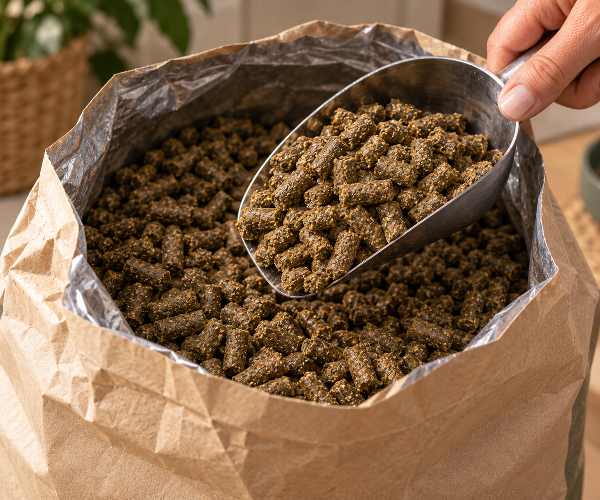
A scoop that looks like roughly 100g might actually contain 120g.
That extra 20g might not sound significant, but twice a day that's an additional 40g every day.
Over weeks and months, those small extras can add up.
We recommend using a simple set of digital kitchen scales to weigh your dog's food.
It takes seconds and gives you a much clearer idea of how much you're actually feeding.
Look at Your Dog, Not Just the Scales
Your dog's weight tells you something.
Their body condition tells you more.
For a dog in an ideal body condition, you would generally expect to be able to feel their ribs beneath an appropriate covering of body fat, see a waist when looking from above and see an abdominal tuck when looking from the side.
This is known as body condition scoring.
If your dog is gradually gaining too much body fat, their portions may need adjusting.
Likewise, if they're losing weight or becoming too lean, they may require more food, although unexplained changes in weight should always be discussed with your vet.
Feed the dog in front of you, not simply the number printed on the bag.
Don't Forget the Treats!
This is one of the easiest things to overlook.
A chew here.
A training treat there.
A piece of cheese while you're making dinner.
Someone else in the house gives another treat because they didn't know you'd already given one...
It all counts.
A commonly used nutrition guideline we use at Bark and Bramble is that treats and other additional foods should generally make up no more than around ten per cent of your dog's daily calorie intake, with the majority of their nutrition coming from an appropriate complete diet.
This doesn't mean dogs can't have treats.
We're a pet company that sells treat boxes, so of course we think treats have a place!
It means knowing what you're feeding and keeping it proportionate.
What About Neutering?
Neutering can affect a dog's energy requirements and some dogs may require fewer calories afterwards.
That doesn't automatically mean every neutered dog needs a special “neutered” food and generally we would recommend to stick with a high protein diet but cut down on grams per day.
It means their weight and body condition should be monitored and their food adjusted if necessary.
The same principle applies as your dog gets older or their activity changes.
Their food intake doesn't have to stay the same for life.
Puppies Are Different
Puppies aren't simply small adult dogs.
They're growing and have specific nutritional and energy requirements.
Their feeding requirements also change considerably during their first year and breed size can influence how quickly they mature.
That's why puppies should be fed an appropriate complete puppy/growth diet and monitored as they develop.
So How Much Should You Feed?
Start with the manufacturer's feeding guide for the specific food.
Then consider your dog's:
- Ideal weight
- Age
- Activity
- Body condition
- Life stage
- Treat intake
- Individual needs
Weigh their portions accurately and regularly monitor their weight and body condition.
Then adjust when necessary.
There isn't one perfect number that applies to every 10kg, 20kg or 30kg dog.
Your dog isn't a feeding chart.
How Bark & Bramble Can Help
This is exactly why we wanted to make choosing and feeding dog food easier.
Our Bark & Bramble Dog Food Finder helps owners explore foods based on their dog's individual characteristics and requirements, rather than simply picking whichever bag looks best.
We also provide feeding information for the foods we stock so you can understand how much your dog may need, how long a bag could last and what you're actually feeding each day.
But even the best calculator should be treated as a starting point.
Ultimately, your dog's body condition is one of the best indicators of whether you're feeding the right amount.
Start with the guidance.
Measure accurately.
Monitor your dog.
And adjust.
Because good nutrition isn't just about what goes into the bowl.
How much goes into it matters too.
better nutrition + transparency + pets deserving better
This article provides general educational information and isn't a substitute for individual veterinary advice. If your dog is significantly underweight or overweight, has unexplained weight changes, has a medical condition or requires a therapeutic diet, speak to your veterinary professional.