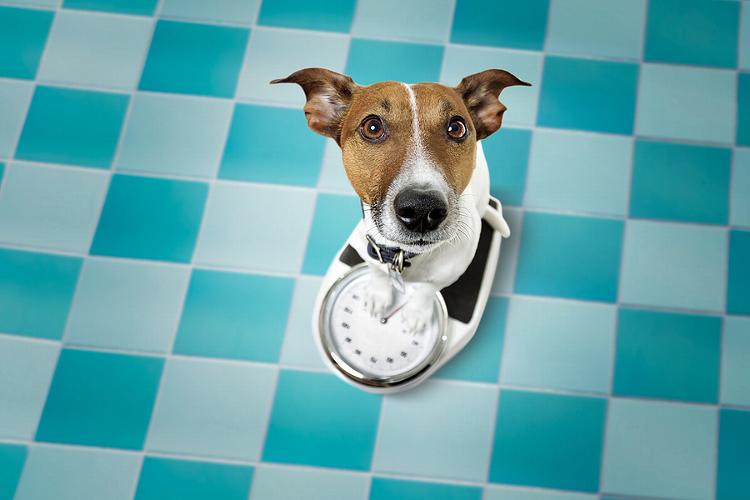
Your dog can look “about right” and still be carrying more weight than is healthy for them.
And because we see our dogs every day, gradual weight gain can be surprisingly difficult to notice.
At Bark & Bramble, we think maintaining a healthy weight is one of the most important parts of looking after your dog's long-term health.
But how do you actually know whether your dog is overweight?
It starts with looking beyond the scales.
Why Does A Healthy Dog Weight Matter?
Excess body fat isn't simply a cosmetic issue.
Being overweight can place additional strain on your dog's body and is associated with health problems including joint and mobility issues, reduced quality of life and several chronic diseases.
Research also suggests that maintaining a healthy body condition could have a significant impact on how long our dogs live.
A large study involving more than 50,000 dogs across 12 breeds found that normal-weight dogs had a longer median lifespan than overweight dogs in every breed studied.
Depending on the breed and sex, the difference ranged from around five months to as much as two years and six months.
Another long-term study involving Labrador retrievers found that dogs fed to maintain a leaner body condition had a median lifespan around 1.8 years longer, alongside a delayed onset of age-related disease.
Of course, keeping your dog lean can't guarantee they'll live a certain number of years longer and genetics, breed, health and many other factors affect lifespan. But the research gives us a very good reason to take healthy body condition seriously.
Even relatively small amounts of excess weight can matter, particularly for smaller dogs.
A healthy weight isn't about how your dog looks. It's about helping them stay healthier, more mobile and potentially giving us more precious time with them.
That's why prevention is better than waiting until weight has become a significant problem.
Don't Judge Your Dog By Weight Alone
There's no single perfect weight that applies to every dog of a particular breed.
Two Labradors could weigh exactly the same but have very different body compositions.
One might be lean and muscular.
The other could be carrying excess body fat.
That's why vets don't rely on the scales alone.
They also use something called a Body Condition Score (BCS).
What Is a Body Condition Score?
BCS is a way of assessing the amount of body fat your dog is carrying.
A commonly used veterinary system scores dogs from one to nine, with approximately four to five out of nine generally considered ideal.
Rather than concentrating purely on kilograms, you look at and feel particular areas of your dog's body.
There are three simple places to start:
- The ribs
- The waist
- The tummy
1. Feel Their Ribs
Run your hands gently along your dog's ribcage.
In a dog at a healthy body condition, you should generally be able to feel the ribs relatively easily beneath a thin covering of fat.
You shouldn't have to press firmly through a thick layer of tissue to find them.
However, the ribs shouldn't necessarily be prominently sticking out either.
The aim is a healthy middle ground.
2. Look From Above
Stand above your dog and look down at their body.
Can you see a waist behind their ribs?
A dog at an ideal body condition should generally narrow slightly between the ribcage and hips rather than having the same width all the way along their body.
If their body looks increasingly rounded or there's little visible waist, they may be carrying excess weight.
3. Look From the Side
Now look at your dog from the side.
Their abdomen should generally tuck upwards behind the ribcage rather than continuing straight across or hanging down.
This is known as an abdominal tuck.
Again, breed and body shape make a difference, so these checks should be considered together rather than relying on one feature.
“But I'm Feeding The Amount On The Bag”
This is something we hear a lot.
The feeding guide on a dog-food packet is a starting point, not a prescription for your individual dog.
Your dog's actual energy requirements depend on factors including:
Age
- Activity level
- Neutering status
- Body condition
- Environment
- Health
- Individual metabolism
Two dogs weighing 20kg don't necessarily need exactly the same number of calories.
That's why we recommend weighing food accurately and monitoring your dog's body condition, then adjusting appropriately.
Don't Forget the Treats
This is where calories can quietly add up.
A chew here.
A few training treats there.
A piece of cheese while you're cooking.
Something from your dinner.
It might not seem like much individually, but it all contributes to your dog's daily calorie intake.
General nutritional guidance recommends keeping natural dog treats and other additional foods to no more than around ten per cent of your dog's daily calorie intake, with the majority coming from their complete diet.
That doesn't mean dogs can't have treats.
It means treats need to be accounted for.
Treat Smarter, Not Necessarily Less
At Bark & Bramble, we don't think managing your dog's weight means they should never be allowed another treat.
Instead, think about what you're giving, how much you're giving and how many calories it contains.
Break training treats into smaller pieces.
Choose appropriately sized treats.
Account for chews.
And remember that your dog doesn't know whether their reward was a huge chunk or a tiny piece.
Sometimes the reward matters more than the size of the reward.
That's also why we've created our Calorie Box, a selection of treats chosen with calorie-conscious owners in mind, with calorie information to help you make more informed decisions about what you're giving your dog.
What About Their Main Food?
If your dog needs to lose weight, simply dramatically reducing their normal food isn't always the best approach.
Why?
Because their complete food isn't just providing calories.
It's also providing protein, essential fatty acids, vitamins, minerals and other nutrients.
Reducing the portion too far could potentially mean reducing their overall nutrient intake as well.
For dogs that genuinely need weight management, an appropriately formulated lighter or lower-fat complete foodmay be a better option.
This is one reason we stock foods designed for dogs with lower energy requirements.
For example, we particularly like DARF Light because of its lower fat content, making it an option worth considering for older, less active dogs or dogs requiring weight management.
The right choice still depends on the individual dog.
Protein Still Matters
Weight management isn't about finding the food with the lowest numbers across the board.
As we discussed in a recent protein in dog food blog, maintaining lean muscle mass matters, including when managing body weight.
That's why we don't automatically look for low-protein food when a dog needs fewer calories.
Instead, we're interested in the overall balance of protein, fat, calories, fibre and essential nutrients.
Lose excess fat, not nutritional quality.
How Often Should You Check?
Don't wait until your dog's annual veterinary appointment.
Get into the habit of regularly:
- Feeling their ribs
- Looking for their waist
- Checking their abdominal tuck
- Monitoring their weight.
Taking a photograph from above and from the side every few weeks can also make gradual changes easier to spot.
Small adjustments made early are usually much easier than tackling significant weight gain later.
If Your Dog Is Already Overweight
Don't crash diet them.
Weight loss should be controlled and gradual, while maintaining appropriate nutrition.
Your vet can help establish your dog's ideal body condition, rule out medical problems that may contribute to weight gain and recommend an appropriate calorie intake and rate of weight loss.
This is particularly important if your dog is significantly overweight or has an existing health condition.
Bark & Bramble's Approach
We love treating our dogs.
Winston certainly isn't going to vote for a treat-free household.
But treating your dog and looking after their weight don't have to be opposites.
Know what you're feeding.
Know roughly how much you're feeding.
Understand the calories.
Monitor their body condition.
Adjust when necessary.
Your dog's weight isn't about achieving a particular appearance.
It's about helping them stay healthy, active and comfortable for as long as possible.
Because our dogs deserve more than simply being well fed.
They deserve to be fed well.
better nutrition + transparency + pets deserving better
This article provides general educational information and isn't a substitute for veterinary advice. If your dog is significantly overweight, unexpectedly gaining or losing weight, has an existing medical condition or requires a structured weight-loss programme, speak to your veterinary professional.